Chapter 1
About the Project
Background of the Study
With unique appearance and excellent mechanical properties, natural bamboo has an irreplaceable position in the field of building materials such as concrete and steel. Due to its unique appearance and excellent mechanical properties, natural bamboo holds an irreplaceable position among structural materials, often rivaling conventional options like concrete and steel in sustainable construction applications. Understanding and effectively managing bamboo resources are pivotal for sustainable utilization.
Traditional methods of measuring bamboo diameter are labor-intensive, time consuming, and often lack the required precision. As the demand for bamboo products continues to rise, there is a pressing need for innovative and efficient techniques to accurately assess bamboo diameter.
The Contour Gauge Technology for Bamboo Joinery is designed to revolutionize the way we measure and visualize bamboo diameters. Unlike conventional methods, this tool can create a detailed and accurate representation of bamboo culms. Recently, students from the Technological University of the Philippines–Taguig (TUP-T) developed a contour gauge technology specifically designed for bamboo joinery, aiming to reduce time spent on manual cutting. This innovation explores the underlying technologies that enable accurate replication of complex profiles and examines its broader implications for bamboo resource management, sustainable fabrication, and product development.
Statement of the Problem
While contour gauge technology has significantly accelerated bamboo joinery by improving measurement efficiency, the proponents from Technological University of the Philippines–Taguig (TUP-T) have identified several limitations in its current form that hinder its practical usability and ergonomic performance.
- Existing contour gauges are excessively bulky, making them difficult to transport and impractical for fieldwork or compact fabrication settings.
- The lack of ergonomic and dimensional optimization reduces usability in environments where space and mobility are critical.
- These limitations hinder the tool's integration into sustainable, small-scale manufacturing workflows.
Therefore, there is a need to modify and miniaturize contour gauges tailored for bamboo joinery to enhance portability, usability, and alignment with sustainable construction practices.
Objectives
General Objective
To modify the design of a 3D-printed contour gauge for bamboo joinery in order to improve its portability and usability for practical, field-based applications.
Specific Objectives
- Analyze the limitations of existing contour gauge designs in terms of bulk, weight, and ergonomic handling.
- Modify the contour gauge with reduced dimensions and optimized geometry for compact transport and ease of use.
- Integrate modular or collapsible features that enhance portability without compromising measurement accuracy.
- Test and validate the usability of the modified contour gauge in real-world bamboo joinery scenarios.
- Examine and determine the most suitable 3D printing filament for fabricating the modified contour gauge, considering strength and printability.
- Compare the previous contour gauge design with the modified, more portable version.
Significance of the Study
Bamboo Industry
Contributes to modernization of bamboo measurement tools, offering a compact and precise solution for joinery applications.
Construction & Woodworking
Enhances workflow efficiency by simplifying the process of measuring irregular bamboo diameters.
Environment
Aligns with eco-friendly practices through additive manufacturing and recyclable materials.
Local Community
Empowers local artisans by making precision work more accessible with modern enhancements.
Future Researchers
Provides a foundation for studies in ergonomic tool design and additive manufacturing applications.
TUP
Showcases commitment to practical innovation, sustainable engineering, and community-responsive research.
Scope & Limitation
Scope
- +Evaluation of existing contour gauge designs
- +Redesigning for reduced bulk and improved portability
- +Selection of suitable 3D printing materials
- +Prototyping and testing in practical scenarios
- +Assessing usability and ergonomic performance
Limitations
- -Limited to measuring bamboo culm diameters
- -Only additive manufacturing methods considered
- -Field testing restricted to controlled environments
- -No long-term durability testing included
- -Prototype supports only Ø7, Ø8, Ø9, and Ø10
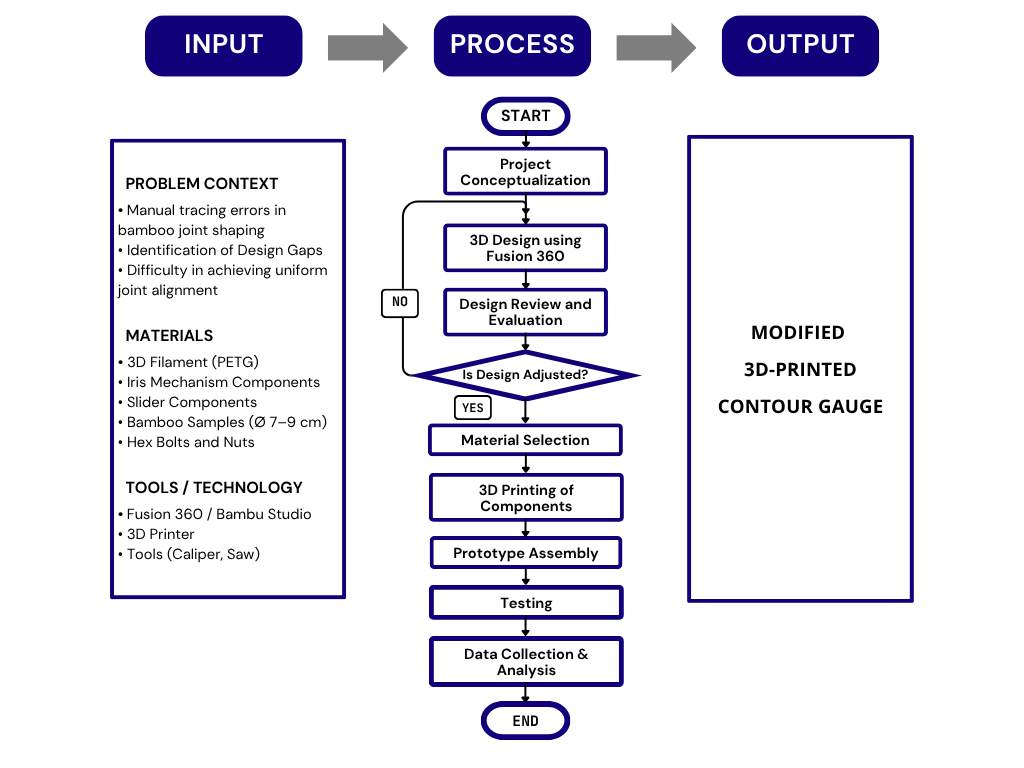
Conceptual Framework
Input-Process-Output (IPO) Model for the development of the modified contour gauge.